Introduction
To expand craft business into markets outside California, the company Crafting S.L. needs our team to determine a plan for weekly production and sales. The goal of our plan is to maximize the weekly profit from selling cloth, yarn, and crafting materials produced by the company. The sales price and production resource of each product are summarized by the following table:
| Price | Cloth | Yarn | Sewing Thread | Craf. Mat. | Labor Hour (min) | Machinery cost | |
|---|---|---|---|---|---|---|---|
| Cloth | 30 | - | 1 | 200 | 0.1 | 30 | 4 |
| Yarn | 9 | 0 | - | 100 | 0.05 | 5 | 2.5 |
| Crafting Material | 20 | 0.75 | 0.12 | 0 | 0 | 50 | 1.5 |
As implied by the table, each product can either be sold or be used to produce other goods. Since the company doesn’t have a warehouse, it needs to buy thread and crafting materials at the start of every week to initialize the production. The price of thread is $0.5 per 100 yards, and there is no supply limit. To buy crafting materials, the company needs to pay $2 per pound due to the payment of interests. Also, the supply of crafting materials is limited to 1000 pounds.
Our plan also needs to take the plant capacities into accounts. The maximum weekly labor hours is 2,000. Each week the plant can produce at most 5,500 meters of cloth, 3,000 skeins of yarns, and 500 pounds of crafting materials.
In the following section, we would use the information above to construct our initial model.
Model
For a clear result, we set up two sets of decision variables:
Production
cp: weekly production of cloth in meters
yp: weekly production of yarn in skeins
mp: weekly production of crafting materials in pounds
Sales
cs: weekly sales of cloth in meters
yp: weekly sales of yarn in skeins
mp: weekly sales of crafting materials in pounds
. The company’s demand of thread and craft materials can be expressed in terms of these decision variables:
thread (yards): 200cp + 100yp
crafting materials (pounds): 0.1cp + 0.05yp
. The total profit is simply the revenue minus material cost and machinery cost:
(30cs+9ys+25ms) − 0.005(200cp+100yp) − (25+2)(0.1cp+0.05yp) − (4cp+2.5cp+1.5cp) . The labor-hour constraints and production capacity constraints are associated to production variables:
$$30c_p + 5c_p + 50m_p \leq 120,000 \\ c_p \leq 5,500 \\ y_p \leq 3,000 \\ m_p \leq 500$$ . Moreover, the production of each product should be enough for sales and secondary production:
$$c_p - c_s - 0.12m_p \geq 0 \\ y_p - y_s - (c_p + 0.75m_p) \geq 0 \\ m_p - m_s \geq 0$$ . Finally, the crafting materials supply is limited:
0.1cp + 0.05yp ≤ 1000 . By integrating all the pieces together, we can formulate the problem as follows:
$$\begin{aligned} \min \quad & 30c_s + 9y_s + 25m_s - 7.7c_p - 4.35y_p - 1.5m_p \\ \textrm{s.t.} \quad & 30c_p + 5c_p + 50m_p \leq 120,000 \\ & c_p \leq 5,500 \\ & y_p \leq 3,000 \\ & m_p \leq 500 \\ & c_p - c_s - 0.12m_p \geq 0 \\ & y_p - y_s - (c_p + 0.75m_p) \geq 0 \\ & m_p - m_s \geq 0 \\ & 0.1c_p + 0.05y_p \leq 1000 \\ & c_s,y_s,m_s,c_p,y_p,m_p \geq 0 \end{aligned}$$ . We choose to apply Linear Programming for this model because it meets the 4 assumptions for LP models:
Proportionality: selling one unit of some product will increase the profit by some constant (price) associated to that product, while producing one unit of some product will decrease the profit by another constant (total cost) associated to that product. Since all prices and costs stay consistent regardless of the sales and production, this assumption holds for the objective function. For the hours and capacity constraints, producing one unit of some product has constant contribution to the labor hours, production loads, and the demand to crafting materials. In addition, when using a product to produce another product, the demand to the resource product is always proportional to the production of the final product. Thus, the assumption also holds for the three consumption constraints.
Additivity: our model divides the effect of a product into the effect of its sales and the effect of its production. Since sales and production are two different processes, the effect of a product can be viewed as the algebraic sum of the sales effect and the production effect. Moreover, the three products have independent prices, costs, and consumption, so the total effect can be represented by the algebraic sum of the product effects. Thus, the assumption holds.
Divisibility: the quantities of cloth, yarn, and crafting materials are fractional numbers by their natures, so this assumption holds automatically.
Certainty: the price, consumption, and capacity data are provided by the company. These data can be measured in detail by the company, so we can assume they are correct and precise. Although the machinery cost can’t be perfectly estimated, we can assume these data represents the average cost in the long run.
Solution and discussion of different scenarios
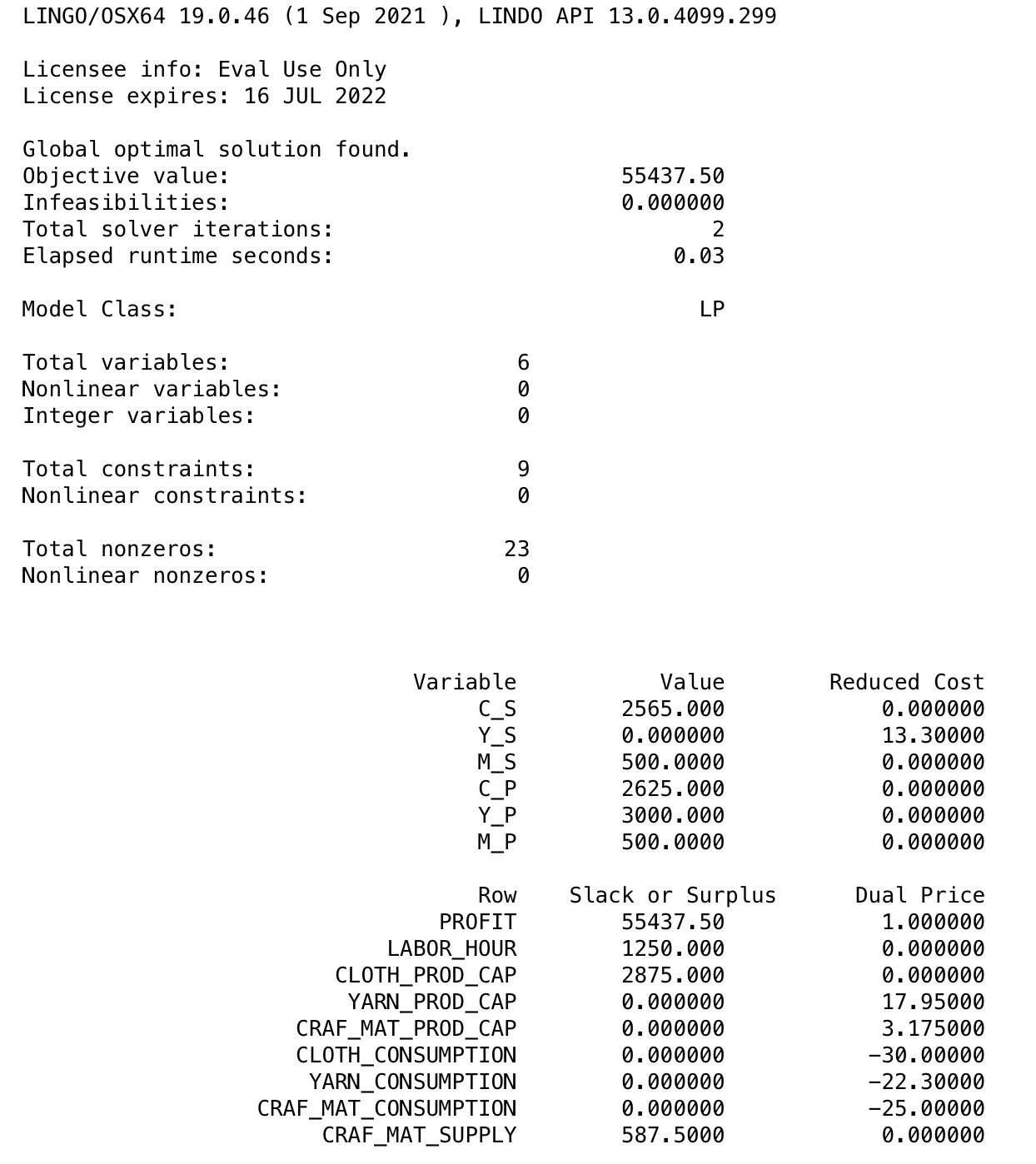
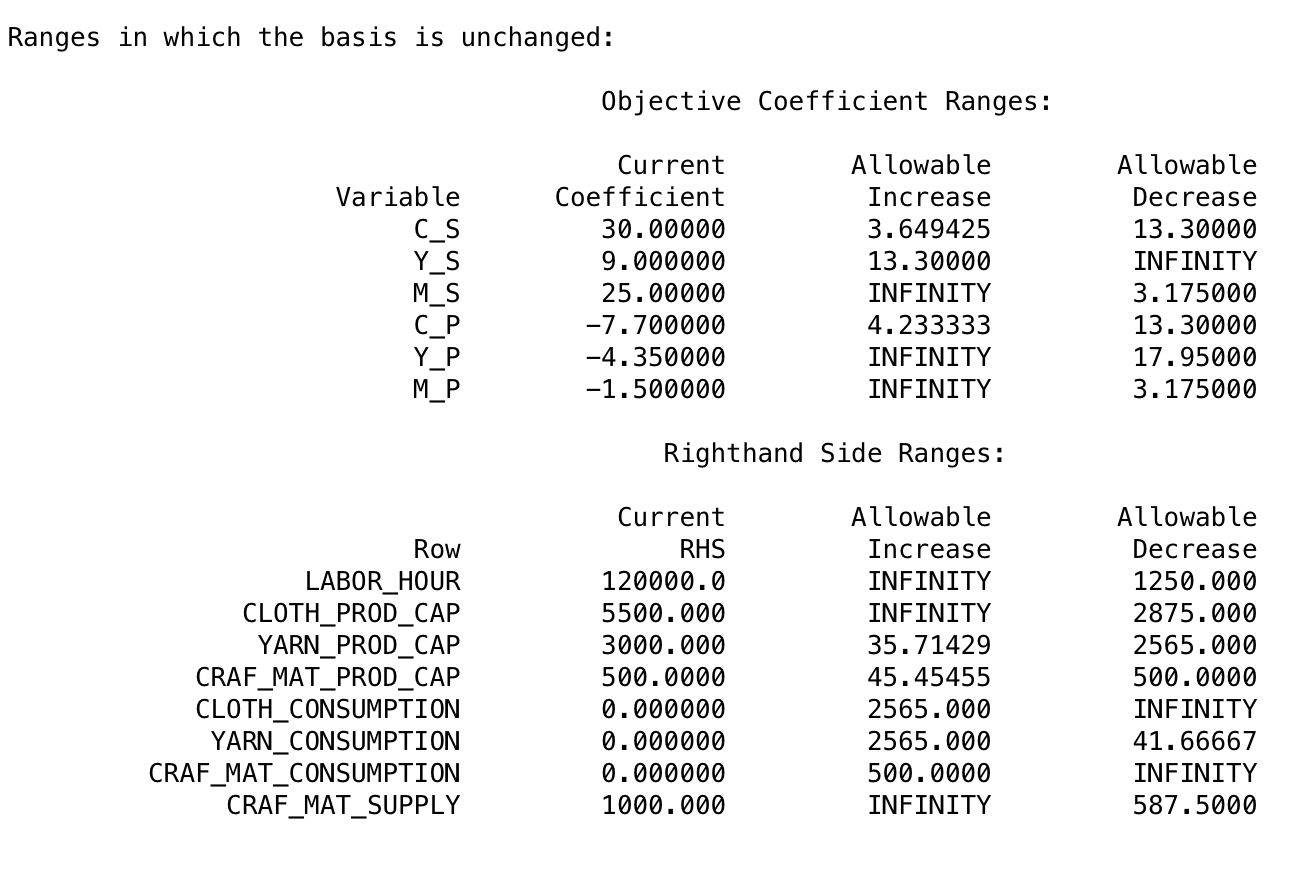
The problem is solved by Lingo software. The software reports are presented in the last section. We will use the two reports to determine the production plan and discuss a number of potential actions can be implemented by the company.
According to the solution report shown in figure one, the optimal combination consists of producing 2625 meters of cloth, 3000 stains of yarns, and 500 pounds of crafting materials. It suggests to sell 2565 meters of the cloth and all the crafting materials. If the company follows this schedule, it will obtain $55437.50 in profit every week.
In the following subsections, we would discuss certain actions the company can implement in different scenarios to affect its profit. We will summarize our recommendations in the next section.
Increasing price of yarn
An increase in the demand of yarn reported by the marketing department may raise the yarn sales price. According to our sensitivity report, a small increase in the yarn price would affect the optimal sales and production plan. Therefore, we can still use all yarns to produce other goods, and the profit won’t be affected.
Although a small increase in the yarn price won’t affect our plan, the sensitivity report shows if the increase is more than $13.3, it would be profitable to sell yarn. The reason is that, the reduced cost of selling one stain of yarn is $13.3. If its price is increased by more than $13.3, the reduced cost would become negative, which implies selling one stain of yarn now has positive effect on the profit. Therefore, if the fluctuation of yarn price is small, we don’t recommend to put it on the market.
Selling yarn to a good client
As discussed above, it is not profitable to sell yarn. However, we are presented with the possibility that a good client of the company may ask it to sell 100 skeins of yarn with the price $11.50/unit. Under the new price, the reduced cost of selling one unit of yarn would be $13.30 − $2.50 = $10.80, which means selling one unit of yarn would decrease the profit by $10.80. Thus, if the request is being accepted, the company will lose $1,080.
Identify new product
If the company wants to introduce other products to production, we suggest to consider those that use yarn as sparingly as possible. As shown by the solution report, the dual price of one unit of yarn is $17.95, which is significantly higher than the dual prices of other resources. Thus, we should avoid using yarn for new product.
Price of cloth bags
Now the production of cloth bags is proposed by the marketing office. The company needs to determine the sales price of the bags. We already knew that producing one bag consumes 15 minutes of labor, 0.3 meters of cloth, and 0.01 pounds of crafting materials. Since the dual price for the labor hour constraint is 0, the cost of labor hour can be ignored, so that we only need to consider the cost of cloth and crafting materials. Given the price of cloth and crafting materials, the total loss can be expressed as follows: $30 * 0.3 + $27 * 0.03 = $9.27 . Therefore, to make it profitable, the price of one bag should be greater than $9.27.
Expanding production capacity
The company may have a $5,000 investment can be spent on expanding production capacity. Suppose this investment will allow to increase 50 meters of cloth production, or 30 stains of yarn production, or 40 pounds of crafting materials production each week. We recommend to increase the yarn production capacity. According to the solution report, the dual prices associated with the cloth, horn, and crafting materials production capacities are $0.00, $17.95, and $3.175 respectively. This statistic represents the marginal worth of one unit of the related capacity increase. The sensitivity report also guarantees that these marginal worth remain constant under the change by the investment. Thus, investing on the yarn production capacity can maximize the profit.
Increasing price of thread
The marketing department also noticed a $0.4 increase in the price of thread for producing cloth. The effect of this increase to our objective function is − 0.8cp. According to the sensitivity report, a decrease of 0.8 to the coefficient of cloth production can be tolerated by the current solution, so there is no need to change our plan. Since the optimal mix is unchanged, the effect of this increase to the profit is simply − $0.8 * 2625 = $2100. In other words, this would make the company lose $2,100 each week.
Warehouse renting
The company has a choice to rent a small warehouse provided by a friend of the CEO for $300/week. The warehouse can store 500 stains of yarn to prevent problems in the chain supply. If we rent the warehouse, we need to produce 500 stains of yarn for stockpiling, so the yarn consumption constraint would become
yp − ys − cp − 0.75mp ≥ 500
. According to the solution report, the dual price associated to the constraint is -$22.3. The sensitivity report also suggests this dual price remains constant when the RHS is increased by 500. Thus, keeping 500 stains of yarn would decrease the profit by $22.3 * 500 = $11, 150. Combined with the cost of the warehouse, the effect on the net profit would be − $11, 450.
Inventories
With the warehouse, we need to find a way to modify our model such that it can simulate existing inventories and desired inventories. Suppose we want the existing inventories and the desired inventories of yarn to be A,B respectively. It follows that the plant needs to produce B − A stains of yarn for stockpiling (when B - A is positive), or it can use an extra A − B stains of existing yarn for sales or production. In either case, the yarn consumption constraint would become yp − ys − cp − 0.75mp ≥ B − A
. What we did is placing B − A to the RHS of the inequality. This method also applies for cloth and crafting materials. As long as B − A is tolerated by the current basis, the effect of this requirement to the profit would be B − A times the dual price associated to the modified constraint.
Recommendations
This section will summarize the potential actions we recommend the company to implement based on the previous section.
For small fluctuation in the sales price of yarn, we recommend not to change the current plan because using yarn to produce other goods is more profitable than selling it. For the same reason, we suggest not to sell large number of yarn to our clients.
If the company needs to introduce new products into production, we recommend to choose the products that use yarn as sparingly as possible because the opportunity cost of yarn is expensive. If the company wants to sell cloth bags, we recommend to price it more than $9.27.
Due to the high dual price of yarn production, we recommend to invest on the production capacity of yarn.
Computer Reports
This section presents the two report generated by the Lingo software after running on our model.